
If you market to other businesses, you already know your sales process looks nothing like selling a pair of sneakers on Instagram. And if you market directly to consumers, you’ve probably noticed that the playbook your B2B counterparts use — long nurture sequences, LinkedIn outreach, multi-stakeholder demos — doesn’t quite fit the way your customers actually buy.
Here’s what often gets missed: beneath those tactical differences, effective B2B and B2C digital marketing plans are built on the same foundation. They share the same structural logic. They require the same discipline. And the mistakes companies make without them are nearly identical.
This is Part 3 of our digital marketing planning series. In Part 1, we covered what a strong B2B digital marketing plan looks like. In Part 2, we walked through B2C planning from emerging brands to enterprise. Here, we put them side by side — where they diverge and where they overlap.
B2B vs. B2C: A side-by-side comparison
| B2B | B2C | |
|---|---|---|
| Primary buyer | Multiple stakeholders (champion, approver, end user, IT) | Individual consumer |
| Decision driver | ROI, logic, risk reduction | Emotion, convenience, identity |
| Sales cycle | 7+ months average | Minutes to weeks |
| Top channel | TikTok, Instagram, Google | |
| Content goal | Build credibility and trust before the sales call | Build emotional connection and drive conversion |
| Content formats | Case studies, whitepapers, webinars, comparison guides | Short-form video, UGC, influencer, reviews |
| Email role | Long nurture sequences across a multi-month cycle | Post-purchase flows, cart abandonment, loyalty |
| CRM focus | Account-level: companies, contacts, deal stages, pipelines | Contact-level: purchase history, segments, LTV |
| HubSpot setup | Multi-pipeline, role-based ownership, association labels | Automated lifecycle stages, behavioral triggers |
| Key metric | Pipeline contribution, cost per qualified lead | Customer lifetime value, retention rate, ROAS |
| Automation payoff | Nurture sequences across a long sales cycle | Cart recovery, loyalty, win-back campaigns |
| Sales team involved? | Yes — demos and direct sales are essential | Rarely — funnel is largely self-service |
| Biggest mistake without a plan | Channel fragmentation, no lead nurturing, weak attribution | Reactive campaigns, poor retention, wasted ad spend |
What B2B and B2C marketing plans have in common
Before getting into the differences, it’s worth being direct about what these two approaches have in common, because the list is longer than most people expect.
Both require a documented strategy.
The single most common reason B2B and B2C marketing underperforms isn’t the wrong channel or the wrong message. It’s the absence of a plan. Disconnected tactics that produce inconsistent results in either market. A documented plan is what connects those efforts into something that builds over time.
Both are built around deep audience understanding.
B2B plans require detailed buyer personas that capture job titles, pain points, budget authority, and decision-making dynamics. B2C plans require behavioral and psychographic research that goes well beyond demographics. The formats differ, but the underlying discipline is identical: you cannot market effectively to people you don’t genuinely understand.
Both depend on multi-channel alignment.
Whether you’re targeting a VP of Operations or a first-time online shopper, your channels need to reinforce each other. B2B buyers move through a combination of SEO, LinkedIn ads, PPC, email, and retargeting before they’re ready for a sales conversation. B2C consumers discover brands on social media, research on Google, abandon carts, and convert through a retargeting ad days later. In both cases, fragmented channels produce fragmented results.
Both require measurement tied to real business outcomes.
Impressions and follower counts don’t mean much in either market. B2B plans need to track pipeline contribution, cost per qualified lead, and conversion rates by channel. B2C plans need to measure customer lifetime value, retention rates, and return on ad spend.
The metrics differ, but the principle is the same: if you can’t measure it, you can’t improve it, and you can’t defend the budget.
Both benefit from automation.
Automated email sequences generate 320% more revenue than manual sends — and that efficiency advantage applies whether you’re nurturing a B2B prospect through a seven-month sales cycle or re-engaging a B2C customer who abandoned a cart. The tools and sequences look different, but the ROI logic remains the same.
Where B2B and B2C plans differ
The buyer and the buying process
B2B purchases involve multiple stakeholders, formal evaluation processes, and buying journeys that research shows average seven months. There’s often a champion, a budget approver, an end user, and an IT or legal reviewer all involved before a contract gets signed. Marketing has to stay relevant and credible across all of them, across an extended timeline.
B2C decisions are faster and far more emotionally driven. A consumer may discover a brand on TikTok, research it briefly on Google, and purchase the same day, or they might take a week and need three touchpoints to get there.
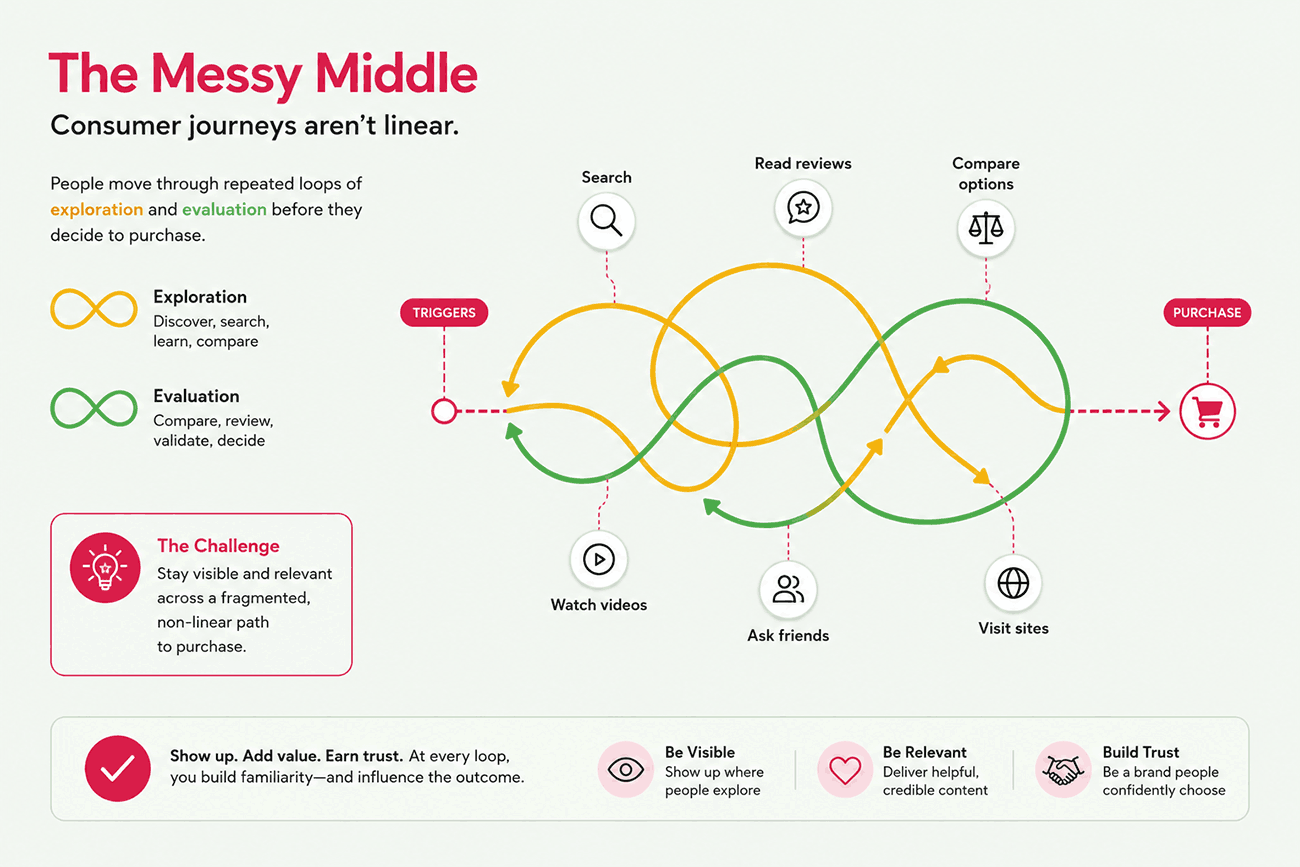
Google’s “Messy Middle” model captures this well: consumers move through repeated loops of exploration and evaluation rather than a clean linear funnel. The challenge is staying visible and relevant across a fragmented, non-linear path to purchase.
Channel priorities
For B2B, LinkedIn marketing should be a top priority. Decision-makers and C-suite members are actively evaluating vendors, building professional networks, and consuming thought leadership content. HubSpot research shows LinkedIn delivers leads at twice the rate of other social platforms for B2B companies. Cold email and targeted outreach remain high-value tactics when the personalization is genuine — a first line that could have been sent to anyone will be ignored.
For B2C, reach and discovery drive the channel mix. Short-form video on TikTok and Instagram Reels generates awareness quickly. Organic search builds up over time. Social proof — reviews, user-generated content, influencer endorsements — carries significant weight in purchase decisions. According to HubSpot’s Consumer Trends research, 41% of consumers discovered a new product on social media within the previous three months.
Content’s role in the sales process
B2B content builds trust before a sales conversation. Case studies, how-to guides, webinars, and comparison content answer the questions buyers are already asking and position your company as the credible choice before anyone picks up the phone.
According to Edelman research, 70% of C-suite leaders say thought leadership has at least occasionally led them to question whether they should continue working with an existing supplier — meaning strong B2B content doesn’t just attract new buyers, it also influences retention decisions.
B2C content serves a different purpose at the top of the funnel. Video, in particular, is the dominant format: 85% of consumers say video influenced a purchase decision. B2C content builds emotional connections, reinforces brand identity, and drives conversions. B2C content builds emotional connections, reinforces brand identity, and drives conversions. Platforms like YouTube Shorts, TikTok, and Instagram Reels are designed for fast content consumption, making it easier for brands to capture attention and engage consumers quickly.
The 2026 FIFA World Cup — happening right now across U.S. cities and here in Atlanta — is a live demonstration of B2C consumer behavior on a global scale.



Merchandise sells out within hours of a country advancing. Social media turns a single moment of a match into a purchasing trigger. National identity and fan culture eliminate price sensitivity almost entirely. Brands that had campaigns ready before the tournament started are capturing that spending. Brands that didn’t are watching it happen.
Nobody illustrates the emotional power of fan identity quite like Norway supporters, who have spent this tournament doing their Viking row…everywhere, on escalators, in train stations, at the stadium, and in Times Square ahead of their match against Senegal (final score: NOR 3 – SEN 2). Viral Viking row videos are spreading across YouTube, TikTok, and Instagram. Check them out!
Your HubSpot CRM setup depends on whether you’re B2B or B2C
B2C HubSpot instances are built for speed, automated lifecycle stages, behavioral triggers, and contact-level data that moves people through a linear funnel. B2B setups require a different architecture entirely: account-level tracking, multiple pipelines, role-based ownership, and association logic that reflects how multi-stakeholder deals actually work.
If your company is considering HubSpot or suspects that your current CRM setup isn’t built for your market, reach out. As a HubSpot Certified Partner, Brown Bag Marketing configures and consults on HubSpot for both B2B and B2C companies. The platform can support both models well. The setup just has to match the strategy.
Sales motion
B2B marketing almost always supports a direct sales process. Discovery calls, demos, and relationship development are part of the deal-closing process. Inbound marketing alone rarely gets the contract signed. The marketing plan has to account for that handoff and ensure sales and marketing are operating from the same strategy.
On the other hand, B2C marketing is typically designed to convert without a salesperson present. The funnel from awareness to purchase is largely automated, and the marketing plan has to optimize every stage of that self-service journey.
When your company serves both markets
Some companies market to both businesses and consumers simultaneously. You don’t need two completely separate marketing operations. But, you do need clarity about which strategies apply to which situations.
Our work in B2B marketing often reveals that companies serving both audiences have defaulted to one playbook at the expense of the other. A consumer-focused brand that starts selling to retailers suddenly applies its Instagram-native thinking to LinkedIn outreach and wonders why it isn’t working. A B2B company that launches a consumer product treats it like an enterprise sale and ends up losing on speed.
Structural clarity is the answer. Define personas for each market, develop channel strategies matched to each audience, and KPIs that reflect how each segment actually buys. A strong marketing strategy accounts for both markets and keeps them from overlapping.
The right plan starts with the right partner
B2B and B2C digital marketing plans aren’t opposites. Both demand a documented strategy. Both require audience clarity. Both depend on channel alignment, consistent measurement, and the discipline to optimize based on data rather than instinct.
Brown Bag Marketing has been building those plans for B2B companies, B2C brands, and businesses serving both since 2002. Whether you need a full-service marketing team, an outsourced marketing partner that works like an extension of your staff, or a strategy built around your specific industry, we’ve done it, and we know what works.
Let’s talk about building a plan that fits your business and your budget.